Clients with a .local domain name appear with the .dhcp-pihole value that I coded in Pi-Hole's DNS.DOMAIN.NAME

Please follow the below template, it will help us to help you!

Pi-Hole is v6 running natively on a Raspberry Pi 4.

I have clients with both IPv6 and IPv4 addresses. IPv4 addresses are allocated on Pi-Hole either statically or via Pi-Hole DHCP. IPv6 are allocated by the client and using multicast DNS. IPv4 DHCP assigns a DNS Domain name of .dhcp-pihole specified by me in Pi-Hole. IPv6 addresses are, via multicast DNS, assigned a Domain name of .local.

This topic may be related to 83995

Thankyou for reading this.

Expected Behaviour:

I would hope that the Pi-Hole dashboard client activity would show the correct Domain names.

Actual Behaviour:

Both the IPv4 and the IPv6 clients appear on the dashboard’s client activity with the IPv4 Domain name. So I see e.g. XPS.dhcp-pihole and XPS.dhcp-pihole instead of XPS.dhcp-pihole and XPS.local.

Debug Token:

https://tricorder.pi-hole.net/h59wy2F4/

Pi-hole is showing the correct domain names.
You should never see any .local DNS requests in Pi-hole's Query Log.

.local is reserved for mDNS protocol usage.
Unless .local is (mistakenly) used as local domain for DNS, clients would strictly resort to mDNS for resolving DNS names ending in .local.

IPv6 addresses may be assigned via several methods, but mDNS is not one of them.

No.
Rather, an mDNS capable client will claim a name for itself, and it does so for its machine's IPv4 as well as IPv6 addresses. Other (same link) mDNS clients can then retrieve name/IP information via mDNS multicasts.

Thanks Bucking_Horn for the education. My first sentence that you corrected would have been better written “IPv6 are allocated by the client and IPv6 is using mDNS”.

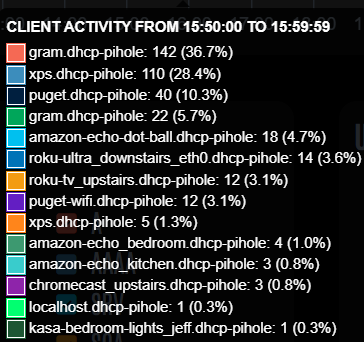
I see my IPv6 capable devices in Pi-Hole as .local (from mDNS). I’d provide an image but I don’t see how to attach one here, so here’s a text version.

CLIENT ACTIVITY FROM 15:50:00 TO 15:59:59
gram.dhcp-pihole: 142 (36.7%)
xps.dhcp-pihole: 110 (28.4%)
puget.dhcp-pihole: 40 (10.3%)
gram.dhcp-pihole: 22 (5.7%)
amazon-echo-dot-ball.dhcp-pihole: 18 (4.7%)
roku-ultra_downstairs_eth0.dhcp-pihole: 14 (3.6%)
roku-tv_upstairs.dhcp-pihole: 12 (3.1%)
puget-wifi.dhcp-pihole: 12 (3.1%)
xps.dhcp-pihole: 5(1.3%)
amazon-echo_bedroom.dhcp-pihole: 4 (1.0%)
amazon-echo_kitchen.dhcp-pihole: 3 (0.8%)
chromecast_upstairs.dhcp-pihole: 3 (0.8%)
localhost.dhcp-pihole: 1 (0.3%)
kasa-bedroom-lights_jeff.dhcp-pihole: 1 (0.3%)

You’ll see there are a couple of clients in there twice. Both clients have IPv4 and IPv6. I show the results from some pings.

ping -n 1 xps

Pinging xps.dhcp-pihole [192.168.0.162] with 32 bytes of data:
Reply from 192.168.0.162: bytes=32 time=50ms TTL=128

ping -n 1 xps.local

Pinging XPS.local [fe80::a280:4576:c5f8:103c%10] with 32 bytes of data:
Reply from fe80::a280:4576:c5f8:103c%10: time=6ms

So, both domain names exist on my network but when Pi-Hole displays them it overrides the .local with dhcp-pihole which, while hardly a major problem, seems to be a bit of a glitch.

Thanks again.

Jeff

In this forum, you can just copy and paste images into your post. :wink:

On a side note: What's the 1 for in that command? What OS's ping are you using?

ping uses several means to resolve hostnames, not just DNS (which also is why ping is not a good tool for analysing DNS issues).
As .local is reserved for mDNS usage, your above command would have used mDNS. Consequently, there wouldn't be any DNS request for xps.local registering in Pi-hole's Query Log for that command.

And as mentioned, mDNS would use IPv4 as well as IPv6, e.g. on Linux, try ping -4 xps.local.

No, Pi-hole doesn't override anything.

The .local names may exist, but they would not be tied to DNS.
As mentioned, they are reserved for mDNS usage, which is designed to allow local hostname resolution in the absence of a DNS server.
Pi-hole is not involved in mDNS.

As explained already:

Hi Bucking_Horn,

You asked what the ‘1’ was for in the ping command. It, combined with the -n, is the number of times to issue the ping. The default is three. The OS in question is Windows 11.

Given all the kind help you’ve provided I don’t want to belabour the point but how can I improve the display in Pi-Hole so that I don’t see duplicate entries. In some way I should see the IPv6 entry (.local) differently from the IPv4 entry (.dhcp-pihole). In the display below you’ll see the duplicate entries (gram & xps) that I refer to.

Thanks again.

Jeff

Thank you.
Windows ping options do indeed differ from Linux, where -n would mean numeric output only and not accept a parameter.

No, as mentioned for the third time, .local is completely unrelated to DNS. mDNS is a separate protocol, and it applies to IPv4 as well as IPv6.

It seems you are wrongly assuming Pi-hole would use mDNS names, and you are wrongly assuming that your .local names would apply to IPv6 only.

You will never see .local appearing in your Pi-hole's Query Log (assuming your network makes correct use of mDNS, and you don't deliberately send requests for such a domain).

And there will be IPv4 as well as IPv6 addresses associated with your xps.local name - check ping -4 xps.local vs. ping -6 xps.local.

But again: That resolution happens completely independent from DNS in general and Pi-hole in specific.

Now, that's different from expecting to see xps.local as client name for a DNS request originating from an IPv6 address.

A DNS request does not contain the requester's hostname, it carries only the requester's source IP (as that's where the reply should go to).
Instead of displaying the original IP in its Query Log, Pi-hole can augment readability by displaying the hostname associated with an IP.

While this would allow to associate a name to an entry in the Query Log, this may produce multiple entries of the same name in statistics that would aggregate by source IP, like the one you've observed.

The interesting question for your case is why any client would send queries to Pi-hole originating from an IPv6 address at all.

Your debug log shows that your router advertises two public IPv6 DNS server addresses:

*** [ DIAGNOSING ]: Discovering active DHCP servers (takes 6 seconds)
   Scanning all your interfaces for DHCP servers and IPv6 routers
   Timeout: 6 seconds

   * Received 96 bytes from fe80::<redacted> @ eth0
     (…)
     Recursive DNS server 1/2: 2620:119:35::123
     Recursive DNS server 2/2: 2620:119:53::123
     DNS server lifetime:900 sec
     Source link-layer address: <redacted>

While there is no sign of your Pi-hole's host machine's IPv6 address, this poses a more serious problem, as it would allow your IPv6-capable clients to by-pass Pi-hole completely.

You should reconfigure your (TP-Link?) router to not advertise IPv6 DNS server addresses.

But that still leaves the question:
How did your clients named xps and gram get to know your Pi-hole host machine's IPv6 address? Did you perhaps manually configure them to use it?

Hi Bucking_Horn,

You are a patient explainer and I'm sorry to be slow to change my thinking. I'm getting old.

(1) I issued the ping -4 XPS.local vs ping -6 XPS.local and indeed saw the expected IPv4 vs IPv6 addresses for XPS. I also issued Resolve-DNSName xps.local (Resolve-DNSName is Powershell's newer NSLookup) and got back

Name Type TTL Section IPAddress


XPS AAAA 1200 Question fe80::a280:4576:c5f8:103c
XPS AAAA 1200 Question wwww:xxxx:yyyy:zzzz:8353:3579:9b3f:7bc3
XPS AAAA 1200 Question wwww:xxxx:yyyy:zzzz:258b:c806:ce49:6d55
XPS A 1200 Question 192.168.0.162

Which also indicates that mDNS contains both IPv6 and IPv4.

(2) You requested that I reconfigure my router to not advertise IPv6 Server DNS addresses. Well, I tried, by deleting those addresses, and received the response ‘This field is required’. Instead of coding the external, OpenDNS, servers at 2620:119:35::123 and 2620:119:53::123 should I therefore code the Link Local address of my Pi-Hole?

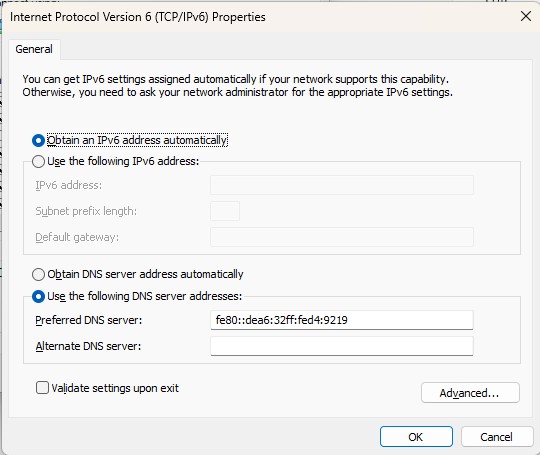
(3) You asked “How did your clients named xps and gram get to know your Pi-hole host machine's IPv6 address? Did you perhaps manually configure them to use it?” and the answer is yes, I coded it in the IPv6 settings.

Thankyou and best regards,

Jeff